


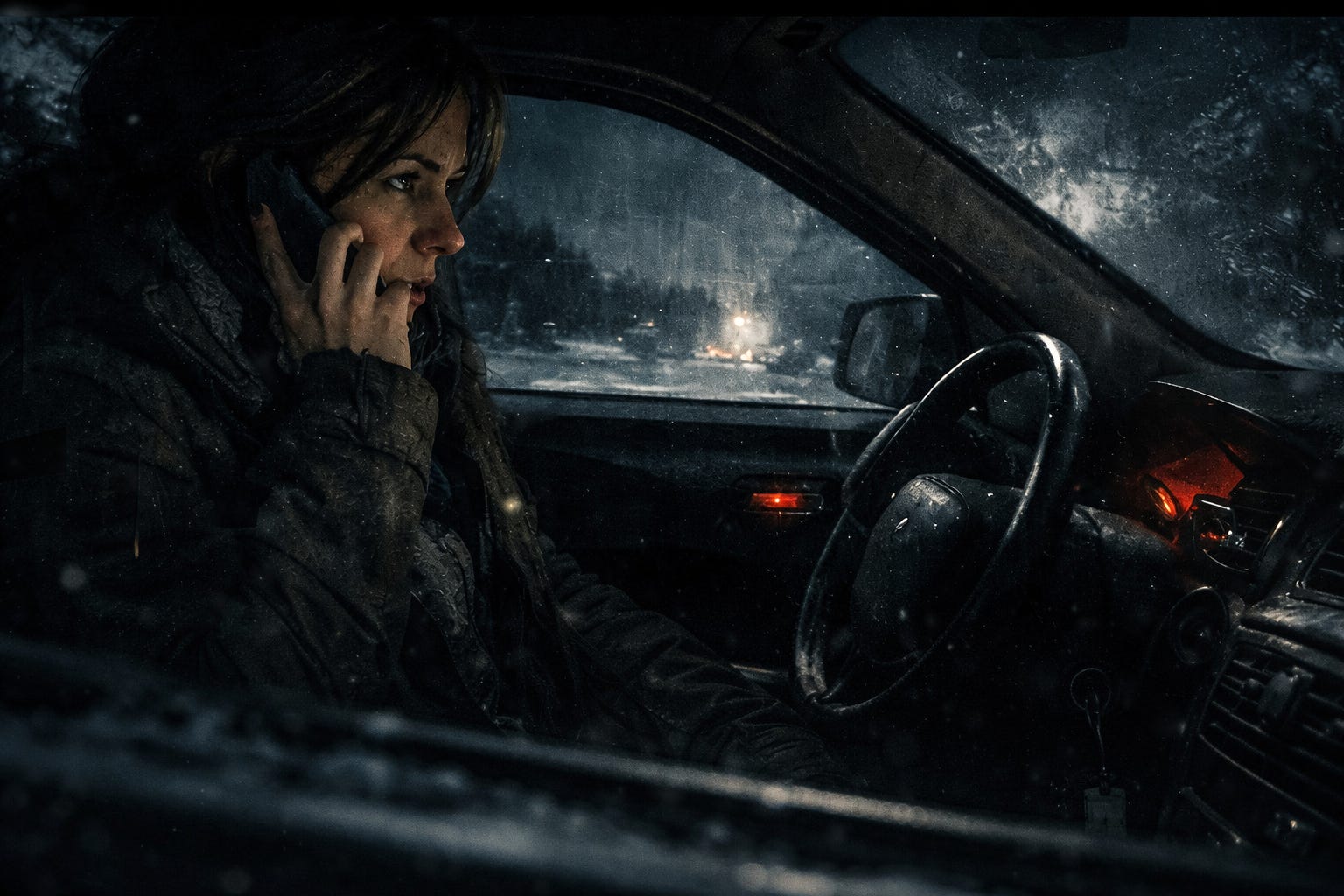
This is the second installment of HALLSTATT, a new serialized paranormal mystery connected to the Westville universe.
One Week Earlier (Catch up on Hallstatt - 1 HERE)
Maybe it was fate. Maybe Arden Cross was meant to be here, called in on this case in Hallstatt, Austria, thousands of miles away from home when it happened.
She wasn’t sure she believed in fate or coincidence. But she did believe in consequence.
Her mother had just called and told her Eva was in the hospital again. Another overdose. Her sister had been clean and sober for almost two years, so far as they knew. The relapse and the timing of it felt cruel, like the universe had a particular taste for bad jokes. The kids—Arden’s niece and nephew—were at her parents’ place. Best place for them to be. They would spend Christmas there, her mother said, and after that they weren’t really sure what things looked like.
“Have you talked to her?” Arden asked, her voice colder and more detached than she meant it to be.
“You know how it goes,” her mother said. “The first few days the doctors need to make a plan. Have some sessions with her. Figure out what’s next.”
“What’s next is a shitshow.”
“Arden.”
“What, Mom? I mean, for Christ’s sake, she’s got two kids to take care of, and now you and Dad have to when you’ve already got enough going on.”
“It’s not her fault.”
“Right, I forgot. The drugs just sniffed themselves into her nostrils.”
Her mother went quiet on the other end after a sigh. Arden stared through the windshield as the road narrowed again, bending along the mirror-sheen dark waters of Lake Hallstatt. Snow and slush hissed under the tires of the rental, the wipers keeping time like a metronome she couldn’t turn off.
The irony was that Arden had seen substances of a different kind worm their way into people of their own volition too many times to count. Nothing her mother could ever know or even begin to comprehend anyway.
“Look, I’m sorry,” Arden said. “I’m just worried about her, about you, the kids. All of it.”
“We’ll be alright. We’re happy to have them here, just wish it was under different circumstances.”
There was a pause on the line, filled with the thin white noise of distance and exhaustion.
“I know you’re not supposed to talk about it, but is it something serious?”
“Serious enough to send in the big guns,” Arden said, trying for joking. “Just a case that might be loosely connected to one of ours.”
“All the way to Europe?”
“Mom. Questions.”
“Right. We’ll call later this week.”
“Keep me updated. I’ll try to check in.”
They hung up.
Arden drove on, and the crystalline lights of the idyllic winter town appeared ahead, nestled along the shore of the serpentine waters.
The snow fell in a suffocating sheet over the town.
Arden sat at the bar of a small pub tucked off the lakeside road, boots wet at the toes where slush had followed her in. The place was narrow and low-ceilinged, all old wood and warm light—dark beams overhead, a few tired Christmas decorations, and a row of mismatched framed photos behind the bar that looked like they’d been there forever. An iron stove ticked in the corner, its heat fighting the draft that sneaked in every time the door opened.
The air smelled like damp wool and fried onions, with the sweet spice of mulled wine underneath. The bartender—middle-aged, apron dusted in flour—moved with the patient rhythm of someone who’d survived a thousand tourist seasons and never once let it show.
Outside the front window, a flickering neon green-and-blue sign painted the glistening sidewalk in one-second bursts. Each blink threw color across the slushy cobblestones and bundled silhouettes drifting past, their laughter muffled by snow and distance. In her mind’s eye the pulsing neon fell into time with the blinking red light at the one intersection in Blakely, a small West Virginia town she’d already spent more than enough time in trying to make things better and right the wrongs that she never could.
She may have been in a different country, but it was the same feeling: small place, big quiet, and the sense that time was playing with her.
If she was lucky, this homicide wouldn’t prove to be that out of the ordinary after all. Get what she needed to know and get back to Langley.
The small-town police were dragging their feet. That, and the police chief had just happened to fall ill with a sudden bout of pneumonia that put him out on a respirator, so there was that.
Arden was two beers deep and thinking of switching to old fashioneds. She watched the bartender build one for someone down the bar, slow and careful, then watched the way the locals pretended not to watch her back. Their conversations stayed low, consonants clipped in German, a few English phrases dropped in for the tourists near the door. Every so often a burst of laughter rose and fell, but it never fully warmed the room. Not tonight. Not with what had happened at the cathedral.
Arden’s phone sat heavy beside her beer. She checked it, even though she knew there wouldn’t be anything new. No texts. No updates that would make this easier. Just the same waiting.
Waiting on the young deputy—a number she’d been able to track down and get a hold of just as he was ending his shift and heading to a family dinner. A fact she felt a little bit bad about, but not bad enough to try and expedite her own departure from this town.
The pub door opened again, and cold air knifed through the room.
Arden didn’t turn right away. She listened first: the scrape of boots, the pause like someone was checking whether they were welcome, the small exhale of relief when the heat hit them. Then she lifted her eyes to the glass and caught the reflection.
Not a tourist.
A uniform. A familiar posture that didn’t belong in a room like this.
Finally.
His face was pale, matching the folds of snow that had been shoved up against buildings on the opposite side of the street, and he had a thick face, a stout nose, but the rest of him was surprisingly gangly in his brown and gray sweater and jeans. Out of uniform. A nametag glinted in the bar light and read G. Bauder.
“Arden Cross?” he asked, his English painted with a German accent.
“Yes,” she said, standing, and reached out a hand. His own was clammy when she shook it. “Thanks for meeting me here.”
“Is this about the robbery?”
He wanted to get right into it. That was fine. Except there was no robbery.
“According to the report I received,” Arden said, “there was nothing taken. From the victim or the register.”
“Yes. But we did in fact notice something missing. After the fact, after the report was made.”
“Wanna fill me in?”
The deputy produced a photo. It showed a small vial in an evidence bag with some kind of powder filling it. Arden’s first thought was drugs, her mind on her sister. But the color wasn’t like any drug she’d ever encountered. The color of—
“Ashes,” she said.
The deputy nodded.
“This was taken from the victim?”
“It seems to have been taken from a drawer behind the counter, where the victim kept it.”
“Assuming it was theirs to begin with?”
“That is our assumption.”
Arden passed the photo back to the deputy. “Do you have the tape with you as well?”
“We’ll have to go back to the station, I’m afraid. Left it there.”
“Alright,” Arden said, taking one last sip of her old fashioned and sliding a tip across the bar. “Let’s have a little watch party and then get you off to your family.”
The drive to the station could hardly be called a drive at all. More like a coast and a couple turns and they were there. The Hallstatt police station building looked more akin to some cheerful Austrian haunt straight out of The Sound of Music, a white two-story with accents of golden brown bricks that made it look like a toasted marshmallow. Just now, amid the fluttering of idyllic snow, Arden half expected when they walked in to be greeted by a boys’ choir chanting gaily in front of an ornate mantle alight with a blazing fire.
Arden got out of the wrong side of the car (despite several assignments here in Europe and around the world in the past few years it still felt that way to her every time) and followed the deputy inside. It was far more plain and drab than all her mind had conjured, and she couldn’t tell whether relief or disappointment were winning out.
The deputy showed her to a room down a gray hallway where video equipment cast a ghostly blue static. He sat down, cued up the footage, and Arden sat in front of the monitor next to him.
The killer walked into the deli. He assessed the clerk, made his decision in seconds. It was quick, calm, almost peaceful looking on the grainy black-and-white display. A hand stretched outward as if in offer across the counter, then that same hand drew the dark-haired woman close, her braid quivering back-facing the camera in the corner. She slumped to the ground as if asleep.
No stab wound. No gunshot. No sign of contusions or lacerations.
It was as if she had dropped dead from a touch that left no trace.
Arden had seen a lot of things in her decade-plus career in law enforcement. Killing with nothing but a gesture wasn’t one of them.
Of course, there was an explanation to be had somewhere. You just needed to know where to look. She would have to wait on the toxicology report. Until then, she could only ask questions. The right questions, to the right people. It wasn’t always easy and she usually didn’t get it right the first time. But it was how she got a case going. Interviews. Profiling. Getting to the bottom of who people were and what roles they played or didn’t play. Who knew who and who didn’t know anyone of interest.
Arden wasn’t sure whether it was the rush of a wide-open field or the macabre sort of fascination that came with a fresh murder case like this one. Either way, no matter how jet-lagged or overworked she was, or whatever else was going on in her life, everything else seemed to dissipate to nothing for Arden in these early hours of working a new case.
That was one thing she’d come to count on.
The footage looped and the figure stepped into frame again.
“Pause it,” she said quietly.
The frame froze two seconds before contact. And there, in the upper left corner of the image—barely visible, barely real—was the cathedral window across the street. The snow had cleared enough that the stained glass was visible through it. Arden leaned closer.
Behind the leaded panes, lit from within by candlelight, a figure hovered. Vestments trailing. Arms out. A full foot off the floor.
“What time did the call come in?” she asked.
“Eleven forty-seven.”
“And the church—all doors chained. No one in or out. You’re certain.”
“For six hours prior.” Bauder cleared his throat. “When we entered, the candles were still burning. Fresh wax.”
Arden sat back. Six hours, sealed, and someone had been keeping the lights on.
She looked at the vial photo again, sitting beside the keyboard where she’d left it. The color of the powder had bothered her since she’d first seen it. Not gray like cigarette ash. Not black. Something in between, with a faint undertone she couldn’t name.
“The deli,” she said. “How far is it from the cathedral?”
“Across the lane. Thirty meters.”
“And what else is on that same block? Same complex?”
Bauder was quiet for a second too long.
“The charnel house,” he said. “St. Michael’s Chapel. It sits directly beside the parish church. They share the same grounds.”
Arden looked at him.
“The bone house,” he clarified, as if she might not know. “Over a thousand skulls. Painted. Families used to have their dead exhumed after a decade and the skull brought there. Decorated with symbols. Roses for love, laurel for valor. They go back to the twelfth century.” He paused. “It is a tourist attraction now. Very popular.”
“Is it accessible at night?”
“No. Locked with the chapel.”
“But you said the candles were burning inside the cathedral.”
“Yes.”
“Do the two buildings connect? Interior access between the chapel and the charnel house?”
Bauder opened his mouth. Closed it.
“I don’t know,” he said, and Arden could tell from his face that he was realizing he should.
She looked at the vial photo one more time. The powder. The color of old bone left in the sun.
“I need to see it,” she said. “Tonight.”
“It’s locked—”
“So was the cathedral.” She stood. “Get me whoever has the key.”
Outside, voices of merriment and a chorus of a choir in from the town center’s advent market emanated like a cheerful phantasm.
Arden stepped back into the night with Bauder at her side. The cathedral loomed dark against the white sky, its steeple cutting clean into the storm.
And then she saw it.
A flicker of gold through the stained glass.
Candlelight.
Still burning.