


What follows is part 2 of the re-serialization of Westville Book 1. New parts drop every Monday and Friday.
If you’re new to Westville and want to dive in, you can get the books on Amazon or signed copies direct from my website:
D.C.B. Interview Transcript
Interview Series 3: The Westville Incursion
Lochlear: Date is December 31st, 1996 — 10:48AM. This is Special
Agent Stephen Lochlear. Please state your full name for the record.
Benson: It’s Casey Benson—for the tenth time.
Lochlear: Your full name.
Benson: Casey. Alan. Benson.
Lochlear: I understand your frustration, Mr. Benson, but this is
necessary. An incursion of this scale requires absolute diligence. We need
to know exactly how the events of these past few months unfolded.
Benson: You call diligence leaving a girl to rot while your people played
spy games in my town?
Lochlear: The situation left us no better choice than to adhere to our
protocols.
Benson: Don’t feed me your bureaucratic bull—
Lochlear: Mr. Benson, please calm down. The sooner we finish, the
sooner you can return home. Things can start to go back to normal.
Benson: You don’t believe that. You can’t honestly think we’re ever
going back to normal after what happened.
Lochlear: I do. Because I have to. And so do you and everyone in
Westville who witnessed what happened. I think you know that.
Benson: Fine. Let’s just get this over with.
Lochlear: Good. Now… from the beginning.
4
OCTOBER 26, 1996
Westville wasn’t the kind of place where people went missing—until one frigid October morning, it suddenly was.
Casey Benson turned onto M-12, the dim, lifeless glow of the Family Affair Supermarket sign slipping from his rearview, the neglected speed gun rolling listlessly in the passenger seat. A grand total of three cars had passed in the last two hours, and the temperature plunged like the speed limit coming into town, the Indian summer breaking like a brittle bone.
The weathermen hadn’t warned about the coming snap, and usually, they got all hot and bothered about that sort of thing. But Casey felt the cold clawing at him now through his open window. He twisted the radio dial away from the drone of political chatter. Static gave way to a story on a severe tornado outbreak overnight in South Dakota and Nebraska, and finally to the slow gallop of “One Headlight” by The Wallflowers. Casey exhaled, eyes flicking to the pale green glow of the clock. 6:56 a.m.
The department was understaffed; taking the night shifts was doing a number on him and his sleep. Not to mention this time of year, everything was dark. The mornings were black and nights blacker, and right now there was only the faintest gray-yellow bruise on the horizon hinting at dawn.
Fog crawled over the road, rolling low as Westville stretched awake in pieces. Hardware and auto parts galore, fast food and pizza, Herb’s lumber and used car dealerships. A small town starter set that Westville never broke out of.
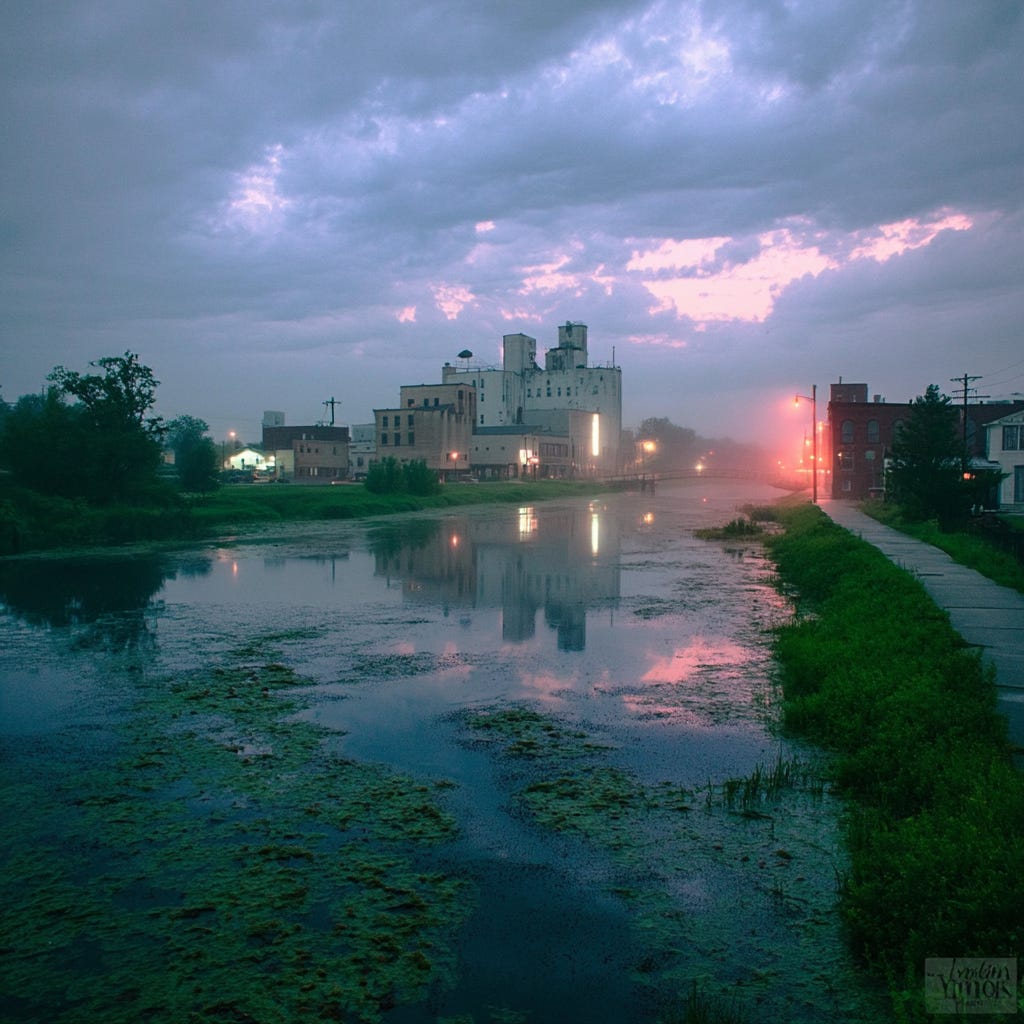
Casey slowed at the blinking red light. Two warring gas stations stubbornly stood at opposite corners of the town’s main intersection—Shell on one side, Marathon on the other—still and quiet. The hulking grain bins of PRINCE Milling loomed overhead, skeletal steel trusses and angled downspouts crisscrossing between them. If Westville had a skyline, this was it—a row of towering concrete silos, the six-letter crimson neon declaring PRINCE like a beacon.
He rubbed his brow, tracing rough skin on the scar there.
The dispatch radio crackled. He ignored it—he was only minutes from the station anyway. The tires hissed on pavement as he rolled forward, past the first block of historic buildings: the two-story antique mall, a tax office, more antique and trinket shops. The five-and-dime on the corner of Water St. and the comic book shop across from it. Westville, the bustling hub of commerce.
Cold mist rose off the rushing dam as he hit the bridge, vapors snaking around the newest silo under construction, sheets of plastic draped over it like a veil. Ahead, the rolling fog cast a ghostly glow over black iron street lamps that lined the half-mile run of Main Street.
The radio squawked impatiently again, but with an odd burst of static—almost like a whisper. Casey frowned, glancing at the receiver.
Silence.
Then a harsh hiss as Gail’s honking voice came through: “Benson, you copy?”
He startled and grabbed the radio. “Yeah, I’m here. Heading your way. Over.”
Another brief squelch. Then Gail again: “I’ve been trying to stave her off, but Ruth Potter’s blowing up the line with another noise complaint. Want to check it out? Over.”
Casey let out a slow breath. His stomach growled, and his eyes burned at the thought of extending his shift. He could already feel food and rest slipping away.
“Not really, but I’m on my way.”
Gail’s smirk was audible. “Copy. You’ll get your reward in heaven.”
Casey snorted as he turned left at City Hall, passed the station, and shot it a baleful glance.
Who needed sleep anyway?
Ruth Potter’s place was just past Elmwood Cemetery, where Harrison gave up on pavement.
Casey had lost track of how many noise complaints dragged him here—or any officer lucky enough. The old yellow two-story stirred up memories: his dad mowing her lawn—another side job to make ends meet—while Casey sat on the back steps, eating gas station Oreos. They always tasted like chemicals thanks to the cloud of mosquito spray Mrs. Potter insisted on dousing him with, her voice sharp as she scolded him to hold out his arms—and let her get behind his knees, too.
He pulled in behind her Buick Century, the rusted car leaning to one side, victim of a flat tire that had probably been that way for months. She didn’t drive anymore, far as he knew. Since Bob passed, her kids carted her around.
Casey barely had time to unbuckle before the front door swung open, hinges shrieking. Ruth Potter stepped onto the sagging porch, wrapped in a floral housecoat, gray hair piled haphazardly atop her head like cotton candy gone wrong.
“About time, Officer,” she barked, cutting through morning fog.
Casey grinned, shutting the patrol car door. “You can call me Casey, you know.”
She huffed, arms crossed over her narrow chest. “Well, I wish I didn’t have to call you at all.”
“Noise complaint?”
“Them kids were at it again,” she said, eyes flashing. “Hollerin’ like they got nothing better to do.”
Probably didn’t. High schoolers in Westville late on a Friday night meant bad decisions in the woods. He nodded anyway, suppressing a yawn, looking toward the tree line across the road.
“By the Scout cabin?”
She lifted a quavering finger, her voice dropping to a mutter. “Saw a red light over in the woods on the hill, too.”
Casey squinted toward the dark forest bordering her property. The land sloped down to the river, and beyond that, the hills of the North Country Trail. The Boy Scout cabin had been a teen haunt for as long as he could remember.
“Red, huh?”
“Yep. Flickering in and out. Better not have been fireworks.” Her lips pressed into a thin line. “Them kids’ll set a blaze.”
Nothing changed in Westville. Same boredom, same reckless midnight activities. He and Joe Thompson had been no different, setting off a dozen road flares stolen from PRINCE Milling’s rigs, just because. Joe’s dad made sure he didn’t leave the house for weeks.
“I’ll check it out, Mrs. Potter.”
She narrowed her eyes. “You do that. And call me Ruth, dammit.”
“Right,” he said, smirking as he climbed back into the patrol car.
He wrote up her report, tapping his pen against the clipboard in time with the engine’s idle. His brain felt like fogged glass, the strain of consecutive night shifts making everything slower, heavier. He thought about just heading back to the station. But Ruth Potter would be watching from the window, making sure he did a proper loop past the cabin. She was persnickety like that.
He sighed and threw the car in reverse. Just for show.
The dirt road dead-ended at a turnaround, the Boy Scout cabin perched on a low hill to the right. A rusted gate, padlocked but laughably easy to climb, shrouded in fog creeping up from the river. Casey had scattered teenagers from this spot before, his headlights flashing through the woods, their laughter turning to panicked curses as they bolted. Sergeant Gordy Reynolds had once likened it to spritzing an ornery cat with a spray bottle.
Casey rolled down the window, letting the cold air rush in.
For a second—he thought he heard something. A low groan. Maybe a dead tree shifting.
The gravel crunching under his tires drowned it out. Nothing looked out of place. He exhaled, turned the wheel, and pulled back toward town.
As he headed back down Harrison, a dog stood on the shoulder where the dirt met pavement. Ears pricked, eyes locked on the tree line, like it was listening to something only it could hear.
Casey glanced at the dog in his rearview, a shiver running through him as he rolled up the window.
5
Casey pulled into the station, just as tired and hungrier, the garage door rattling down behind him. The hum of fluorescent lights buzzed overhead, and from Johnson’s cubicle, a boombox crackled, Metallica playing at a moderate volume on K-ROCK 94.9.
Things were quiet. Relatively.
Gail sat behind the reception desk, a jar of peanuts and candy corn perched precariously near the edge. It never seemed to empty, so either it was going stale or she had a sweet tooth and refilled it when no one was looking. She was focused on her daily crossword.
“How’s Ruth?” she asked, smirking.
“Thoroughly annoyed, surprisingly sharp, and ears like a bat.”
“Maybe we should hire her, then.”
“No argument there.”
Casey caught Travis Johnson—the department rookie—up to speed on the night’s events. Which, aside from the cold snap and the false kegger, was a whole lot of nothing.
He was finishing the last of his coffee when Travis cleared his throat. “You used to go out with Allison Fischer, right?”
Casey clenched. “We talked for a while,” he lied. It had been more than that. And it didn’t end well.
“Thought about asking her out.”
Casey paused, glancing up. “A little old for you, huh?”
Travis grinned, rubbing a hyper hand over his blonde buzzcut. “I’ll take that as a yes.” He proceeded to back out of the kitchen in exaggerated display—and promptly crashed into Sergeant Gordy Reynolds.
“Watch your six, son,” Reynolds said.
“Sorry, Sarge.”
Reynolds nodded at Casey. “Another night in the trenches, eh, Benson?”
“Something like that.”
The sergeant refilled his maize-and-blue U of M mug, glancing at a copy of the Westville Ledger with a headline that read DNR Investigating Deer Decapitation. He pulled a McMuffin from a crinkling McDonald’s bag, unwrapped it, and bit into it with a grotesquely loud, wet chew. Casey thought of his time in Chicago when headlines screamed about shootings, muggings, and murder. In Westville, some decapitated deer ranked as major foul play. Creepy, sure. But Casey had no reason to think much of it.
“Well, Benson,” Travis barked, heading toward the garage, “I’ll make up for your share of the ticket quota this morning.”
He walked with a stocky arms-out gait, and Casey swore he ordered his uniform one size too small on purpose. He had won the department MCOLES fitness challenge, granted, but given his only real competition at this point was Casey, it wasn’t saying much.
“Have at it,” Casey called after him. Reynolds shook his head.
After clocking out, Casey changed in the locker room, swapping his uniform for a flannel, undershirt, and jeans. He ran a hand through his matted brown hair—probably getting too long for department standards—and caught the twitch of his left eyebrow in the mirror. He’d had it ever since he fractured his orbital bone on a rusty trampoline at twelve, leaving him with a slight droop of his left eyelid—ptosis, the doctor had called it. His dad had taken the diagnosis with skepticism, as if waiting for a punchline that never came. There wasn’t much to do about it, so Casey learned to live with it.
The running joke had been that it knocked him smart, since his academic aptitude went from mediocre to advanced in a hurry not long after. Casey never felt all that smart — more like he guessed right a lot and went with his first impulse. He didn’t study nearly as hard as his fastidious older sister Mel, much to her chagrin. Truth was, he’d just decided to try — maybe to make up for the way his new look bothered him. Nineteen years on, the crooked brow was just another mark of the past, wanted or not.
His thoughts drifted—unwanted—to the roadside memorial he’d passed earlier that morning. A white cross. A wreath of dead, dried flowers. He shook the image away, grabbed his bag, and headed for the door.
“Benson, watch the phones for a minute?”
Gail didn’t wait for an answer, already hobbling off toward the ladies’ room.
“Sure thing,” Casey muttered to no one. His stomach growled. Eggs and bacon at Fischer’s sounded good. Maybe a waffle or two. But Aly was probably working. And truth be told, he didn’t have the energy.
Still, Travis’s comment had stirred something up in him. She’d been back in town six months now, ever since her dad passed, helping her mom run the restaurant. He hadn’t seen much of her since the funeral—and before that, it had been two years since he broke things off. In a town of three thousand, though, you couldn’t avoid each other forever.
The sharp trill of the phone cut through the silence. Casey let out a resigned sigh and picked up the receiver.
“Westville Police Department, Officer Benson speaking.”
A beat of static-laden silence. Then a shaky inhale. A woman’s voice, tight with panic.
“Casey? It’s Erin.”
Erin Thompson.
Casey’s first thought was Joe, passed out behind Riverbend again. Or worse—his car in a ditch or wrapped around a tree. Westville had seen its share of tragic wrecks. He pushed down the worst assumption.
“Hey. Everything alright? Joe okay?”
“What? I mean—it’s not Joe.” Her voice wavered.
“Erin, what’s going on?”
A sharp breath. Then—
“God, I’m sorry… it’s Millie.”
A cold weight settled in Casey’s gut.
“She didn’t come home last night. I—I don’t know where she is.”
His mind spun.
“Maybe she stayed over at a friend’s and forgot to tell you.”
“I’ve called everyone. I don’t know what to do.”
Casey tried to think.
“I’ll be right there.”
6
Olivia Fischer woke with the taste of sick in her mouth.
She groaned and rolled over, every inch of her body protesting. The moment she moved, a thick wave of nausea surged up her throat — punishment for the cocktail of weed and cheap whiskey Brett had stolen from his dad’s liquor cabinet. Her tongue felt like sandpaper, her palate sour, and when she breathed in deep a skunky stench clung to her nostrils. She reached for her matted red curls, pulled them close, and sniffed.
Yep. Biggest offender.
She rubbed her face, trying to piece together where Friday night ended and Saturday morning began. The blue curtains in her room were slightly drawn, and through the gap, gray light cut through, making her wonder just how late she’d slept in.
The house was too quiet.
For a second, panic flared—then she remembered. Kathy—Mom—was out of town. That was the whole reason she’d let loose last night, the reason she’d felt bold enough to down Jack Daniel’s like she wasn’t fourteen and stupid. Normally by now Mom would have poked her head in, fresh from opening the restaurant, nagging Olivia to get up, get dressed, be useful. But if Kathy was with Aunt Stacy this weekend, that meant Aly was running the restaurant in her absence. Her jaw clenched at the thought of her much older sister, who’d moved back from Lansing permanently to help Mom run things after Dad died.
Six months already, she thought, choking down the realization. Some part of her knew she should feel more than she did. But truth be told, by the time he was gone, she’d been ready for him to be. Or at least, that’s what she told herself. Well before he got sick, he and Kathy had been nothing but at each other’s throats, stressed over the restaurant and who knew what else. After that, Dad hadn’t been himself the whole last year.
Brain cancer, as it turned out, was a bitch.
Olivia shoved those thoughts away, blowing a tangled mess of curls out of her face. The silence pressed in around her, thick and suffocating, amplifying the pounding in her skull. She let her mind drift back to the night before. Brett. Matt. Some sophomore girls whose names she never bothered remembering.
And—
Millie.
The thought hit her like a slap, and Olivia bolted upright—only to immediately regret it as her stomach churned violently. She closed her eyes, replaying their argument.
You just had to have your fun, didn’t you, Liv?
Her throat tightened. She needed to fix this.
And she knew exactly how to do it: O.C.P.
The two of them. Four months ago on a hot July afternoon. Riding in the back of Mr. Thompson’s new truck from the Lakeshore with the windows down, screaming along to Naughty by Nature until their voices gave out, clutching their gas station loot.
“You down with O.C.P?” Millie sang, waving her half-eaten Oatmeal Creme Pie in the air like a microphone.
“Yeah, you know me!”
Olivia had nearly choked on hers, laughing so hard she couldn’t breathe. She’d needed to laugh, then.
Olivia dragged herself out of bed, ignoring the protest in her skull, and threw her hair into a painful ponytail with a teal scrunchie. She cracked the window, wincing against the gray morning glare, and stuck her hand out into the chill and a soup of fog. She grabbed cargo jeans from the floor, sniffed her windbreaker, gagged, and swapped it for a salmon Reebok sweatshirt over her Green Day tee.
Then—without thinking twice—she grabbed her bike and headed out.
The cold wet air slapped her awake as she pedaled toward the 7-11. Ahead, fog hung thick, swallowing the Main Street buildings in gray haze. She squinted up at the PRINCE sign, its red glow bleeding through the mist, and crossed just as a pickup roared through the fog with headlights off. She swerved, heart lurching, and called after the driver in a creative combo of curses that probably made her prudish grandmother roll over in her grave—God rest her soul.
By the time she rolled up to the convenience store, she had her breath back.
She grabbed OCPs, a Coke slush, and two straws. The perfect peace offering.
As she headed for the Thompsons’, something settled in her gut—cold and heavy, making her shiver. Maybe it was the cold snap. Maybe it was the guilt, heavy and sour, from ditching Millie and indulging in last night’s whiskey and weed. She hadn’t hated the way it felt at first—the warmth, the looseness—right up until she’d thrown up on Brett’s shoes. But as she rode past the old high school and banked onto Millie’s street, a creeping dread clawed at the edges of her thoughts, growing stronger with every stroke of the pedals.
Olivia skidded to a halt.
A police car sat parked in front of the house. Her chest tightened as she stood there, legs akimbo over her bike, frozen.
Why was there a cop here?
The cold she’d been trying to ignore now felt brutal, like ice sinking into her skin. She felt sick all over again.
Olivia slunk around the side of the house, heart hammering. Some part of her screamed to turn back, but she couldn’t. She reached the backyard, creeping toward Millie’s slider door. Her breath fogged the glass as she peered inside.
Millie’s room was empty. Pristine. The bed was made — neat and perfect, just like Millie always kept it.
Her stomach dropped.
So where is she?
From inside the house, she heard voices. Adult voices. Serious voices.
Her pulse pounded in her ears, every nerve in her body screaming for her to listen.
But something told her she wouldn’t like what she was about to hear.
Within three minutes of hanging up the phone, Casey was walking up to the front porch of Joe and Erin’s house, a two-story historic home four blocks from the station.
Reynolds hadn’t liked him taking the call—he was already over his hours, out of uniform—but everyone else was tied up, and Chief Hart was off for the day hunting up north. He took the cruiser since technically it was police business. His own boat of a vehicle—grandpa’s old silver ’71 Monte Carlo—sat in the drive at his duplex. He walked the mile to the station most days when he could, and to most places in Westville. It helped him think, and sometimes helped his migraines.
Casey knocked, though he didn’t need to. Joe had offered him the spare bedroom when he’d first moved back, said he could stay as long as he needed. It would’ve saved Casey from renting, but it became apparent quickly that Joe and Erin had enough to work through without him haunting their hallway. He felt for his friend, knowing that Joe had wanted to get out of this town with Erin, but when they got pregnant just out of high school it seemed to have sealed his fate as heir apparent to the PRINCE throne.
Inside, Erin was in her blue scrubs, just off a shift at the nursing home or late for one. She was yelling at someone over the cordless phone, voice sharp, frustration crackling through every syllable, before slamming it down. The plastic receiver toppled to the floor, and Erin slapped a hand against the counter, her jaw clenched so tight it looked like it might crack.
Casey walked over, picked up the phone, and set it back on the receiver.
Erin exhaled sharply, wiping her eyes. “Didn’t hear you come in.”
“That Joe?” Casey asked, nodding toward the phone, though he already knew.
Erin gave a tight nod. “He’s on his way.”
Casey sighed. “So Millie wasn’t planning on staying anywhere last night?”
“No. And if she was, she would’ve told us.” Erin’s voice wavered. “This isn’t like her.”
Casey agreed. Millie, for all intents and purposes, might as well have been his honorary niece. And Millie was not reckless. She wasn’t the sneaking-off, lying-to-her-parents kind of kid.
“How long’s it been since you saw her?”
“She left here for the football game around six.”
Right. Games were being played down at Birch Field by the fairgrounds one more season, since the new stadium wasn’t finished yet.
“Who was supposed to pick her up?”
Erin hesitated. Glanced at the phone.
“…It was supposed to be Joe.”
Casey’s stomach turned. He already knew where this was going, but he hoped he was wrong.
Three weeks ago, Roger Osmond at Riverbend Saloon had called the station saying Joe was passed out in the men’s bathroom. Casey had picked him up, like too many times before.
“I know, Case. I know,” Joe muttered, wiping his mouth after puking on the side of the road.
“Erin needs you sober. So does Millie.”
“Don’t tell me what my family needs.”
“Well, maybe you need to hear it.”
Joe had stayed quiet after that, until they pulled up to the house. “You’re a good friend, man.”
“I’d rather not be the kind of friend who has to pick you up outside a bar.”
“I’ll be better.”
“You need me to take you to get the truck tomorrow?”
“I’ll figure it out.”
Casey had hoped that he would. That it would be the last time. Apparently, it wasn’t.
He forced himself back into the present.
“So Joe wasn’t around last night.”
Erin shook her head. “No. He was up at the cabin, ‘clearing his head’ again.” She really laid on the air with the air quotes. “I couldn’t reach him.”
“Who would she have been with at the game?”
“She said she was meeting Liv.”
Casey frowned. Then it clicked. Aly’s younger sister.
Erin’s voice tightened. “What do we do now?”
“First we should file a report.”
Erin nodded, eyes glistening. He grabbed the phone, calling Gail at the station. “We’re coming in. Let Reynolds know.”
Erin sighed. “Let me grab some things.”
Casey nodded, leaned against the counter near the fridge. He winced against a blooming, fatigue-induced headache.
Then something slapped to the floor.
Three fridge magnets had slid down. The biggest, a ceramic green frog holding an umbrella and a thermometer, fell to the ground completely, cracking off one bulbous eye. It had clipped a Polaroid photo of Millie with none other than Olivia Fischer, posing and laughing on the train trestles by the dam.
Casey replaced the magnet on the fridge and set the eye on the counter, just as Erin reappeared from down the hall.
They walked out the door just as Joe’s new blue Ford roared down the street. He parked it crooked, left it running, and jumped out.
Joe had the Thompson height and a few inches on Casey. When they were kids he was the far superior athlete — Casey chasing his stats on the basketball team, and in general much less confident, cool, and collected than his friend, who had essentially been the figurative and literal “Prince” of Westville High. Even with the increase of flab too much alcohol often brought with it, Joe was undoubtedly stronger, though Casey had tried to buckle down since becoming a cop, picking up running and biking again. Joe had also inherited his dad’s receding hairline, retaining a thin covering of blonde. Casey at least had fuller hair. Small victories.
Right now, his friend looked like crap — bags under his eyes, a slack look to his mouth, moving slow. Probably more than just a bad night’s sleep.
Joe pulled Erin into a hug, and for a moment she fought it before she folded, body racked with sobs.
Casey might have been pissed at Joe, but now wasn’t the time.
“We were heading to the station to file a report,” he said, voice even.
Erin shoved Joe off, stepping back. “Dammit, Joe. Why do you do this?”
“Erin—”
“Just don’t.”
Erin bit her lip, sidestepped as Joe reached for her shoulder, climbed into the passenger seat of the truck, and slammed the door.
Joe ran a big hand down his face. “…I’m sorry, Case.”
Casey shook his head, tried to offer his best consolatory smile, and glanced toward the passenger side door where Erin sat. “Don’t apologize to me.”
Joe sighed. “Right.”
Casey nodded. “Meet you at the station.”
He got in his car and pulled away, mind already running through the next steps. They needed to talk to anyone who might have seen Millie last. And right now, that looked like Olivia Fischer.
His brow twitched as he banked left. He hadn’t mentioned to Erin or Joe the sinking feeling he had as Ruth Potter’s noise complaint clawed at the edge of his mind.
A red light flickering in the woods.
Kids partying and yelling by the cabin.
Or maybe just one kid screaming.
He didn’t want to think that way. The friend in him refused to entertain it. But then, thinking in best-case scenarios wasn’t part of a cop’s job.
Still, he pushed the thought down. Not yet. It wasn’t the next logical step.
They needed to talk to anyone who might have been the last to see Millie.
They’d start with Olivia.
The pickup snarled out of the drive.
Olivia crouched low by the fence, pulse hammering, hoping they wouldn’t spot her bike. She peered around the corner, catching a glimpse of Mrs. Thompson’s face in the passenger seat — red, twisted, crumpled with something Olivia didn’t want to name.
She wanted to believe Millie was in the backseat of that pickup. Or in the cop car, ready to tell them everything. If it meant ratting Olivia out for smoking pot and drinking stolen whiskey down by the dam — that would have been better. Because it would mean she was safe.
But Olivia knew what she’d heard. Hangover or not, she knew.
Millie hadn’t come home last night.
Her stomach twisted violently, and she thought she was going to vomit all over her Vans. She swore percussively under her breath, remounted her bike, and tore away from the house, pedaling toward downtown.
I should’ve just gone back with her.
She thought of those news stories of girls gone missing. Her chest tightened.
As she neared the police station, paranoia spiked. She yanked the handlebars, veering hard onto the riverwalk, cutting across Main Street, pushing toward the woods near the river behind the row of historic buildings where the train tracks crossed the water.
The farther she went, the colder she felt.
Then she screeched to a halt.
A postcard-perfect view stretched before her — a snapshot from someplace called Reality, Michigan.
Welcome back, Olivia Fischer.
The train trestles stretched over the frothing river, the dam roaring beneath. The sound drowned out everything else.
Later, Olivia would realize this was the last place anyone had seen Millie Thompson.
Later, she would realize that last night, she had done more than just make a stupid mistake.
She had damned Millie Thompson.