

Despite how tired I am when I fall into bed, sleep won’t come.
What am I doing here?
I came all the way out to the middle of nowhere—Montana—only to learn I’d inherited the world’s most dilapidated prototype of a general store. A charred, ransacked husk. How much could I really clear from selling it?
Something would be better than nothing, sure, but if I don’t sell it fast—and if I don’t get Kathleen some decent pages—the prospect of having enough cash on hand to cover my parents’ next mortgage payment was slipping further and further away.
But I have to find a way. There isn’t any other option.
I toss and turn. Out my window, a dark-blue pall of clouds hangs on the horizon. Eventually I kick my legs off the bed and drift to the glass.
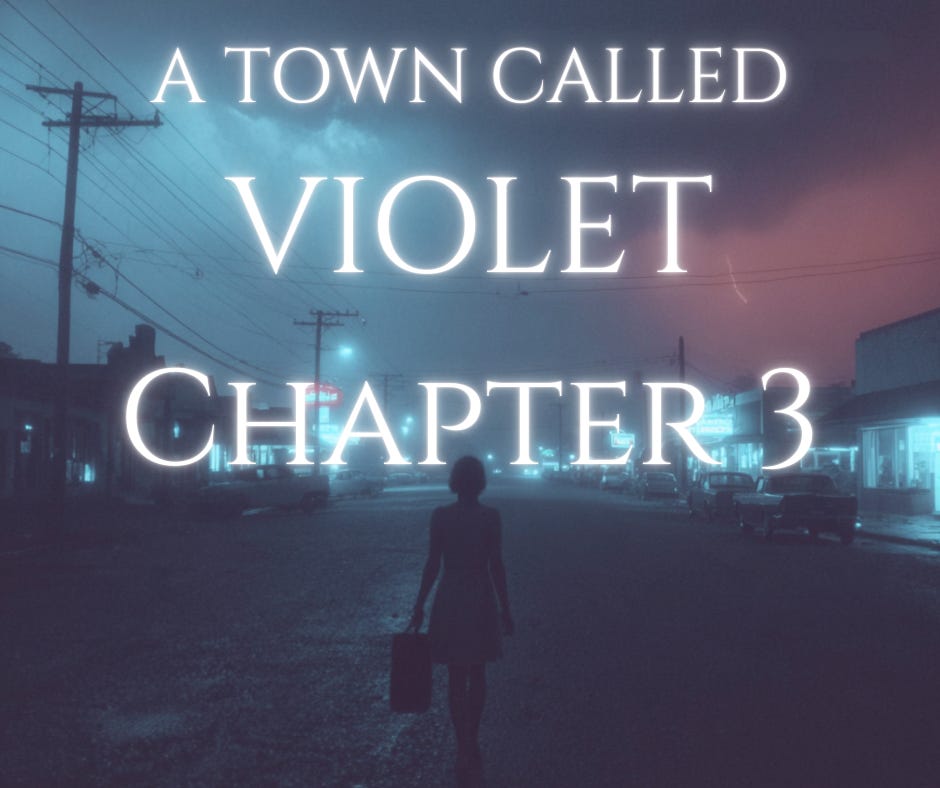
The town is quiet, with only a handful of people spilling out of the saloon below. Laughter, a door slamming, then silence again—like Violet is holding its breath between sounds.
My eyes drift to the general store down the drag.
There isn’t much to see, and I’m not going to get any cleaning done tonight in the dark even if I feel up to it, and Room said the power wouldn’t get turned back on until tomorrow sometime.
Still, something impels me toward it—nervous energy that won’t let me rest. There has to be more to this. The letter gave me a flicker of hope when it came, a way out.
But what I really need is a way forward.
Something to keep me going.
I have to find a way to make it work.
I walk down the stairs into the Cheyenne’s lobby. A fire burns in the hearth. There’s a coziness to it as the wood crackles and embers rise, and it’s silent apart from that.
A stirring to my right.
“Mr. Breaker,” Clara says cheerfully from behind the counter. “Anything I can help you with?”
“No, I’m good, thanks. Just going out for a little walk.”
“Going to check out that store of yours? I hope you get it back up and running again. It used to be the heart and soul of the town. Would be neat to see it come back to life.”
“Won’t be me who does it,” I say. “I might be selling to Rudy Armin.”
“Oh.”
Clara’s smile falters. Not much—but enough.
She turns and wanders back toward the office.
Why was she so disappointed at the prospect of Rudy buying the store? In a little town like this, people knew everything about each other, so maybe Rudy had a reputation for being a curmudgeon, though he’d seemed nice enough to me. Or maybe it was simple economics: if one guy owned the diner and the general store, you’d have a good old-fashioned miniature monopoly on your hands.
But something tells me there’s more to it.
I reach the door when Clara calls after me, “Oh! You might want this.”
She’s holding up a flashlight.
I walk back and take it. “Thanks.”
“No problem,” she says, bright again, like the moment before never happened. “Hope you find what you’re looking for.”
Clara wanders off with that dreamy grin on her face.
She’s an odd one.
A couple of minutes later, I’m standing in front of Breaker General Store.
I put the key in the lock and push the stubborn door open. It scrapes against the wooden boards as if the building itself doesn’t like being disturbed. I flick on the flashlight and step inside.
The beam carves through a pall of dust and sends it swirling like smoke.
The place is a wreck. Shelves ransacked, some tipped over. Random canned goods, years rotten, swollen and ruptured—fermented into something gelatinous and wrong. Newspapers melting into the wood. Torn shreds of books and magazines from the rack on the far wall.
There’s a room in back with an old chest freezer. It’s dark, and only the faintest gray slats of light pierce through partially boarded windows. Must and rot pervade my nostrils, the scent so strong I’m surprised my feet don’t sink through the floorboards with a wet crunch at any given moment.
An old cash register sits on the counter, cobwebbed from years of stillness. I walk behind it and pop it open.
The sharp ding resounds in the silence.
Inside is a handful of assorted coins, sorted by denomination. I pick up a quarter.
The mint date reads 1938.
There are partially disintegrated bills, too.
Guess those are mine, as well.
I close the register and leave the cash inside. No sense adding “petty theft” to my growing list of spiritual ailments.
I resume my slow circuit around the store, the flashlight revealing more of the same—debris, broken glass. Rudy had mentioned vandals being a problem. I’d imagined kids.
Then I see the words carved into the wooden wall to my right, the beam lighting them up one by one:
MURDERER
YOU RUINED THIS TOWN
GOOD RIDDANCE
And finally—the most disconcerting of all:
IT WILL HAPPEN AGAIN
What will happen again?
The store catching fire? Violet getting struck by lightning? Unless there are lightning rods all over the roof that I somehow missed, the notion seems… optimistic.
Then my eye catches on a photograph behind the register amid a sea of debris. A face only vaguely familiar at first—hard lines, squared-off jaw, eyes squinting in a posed photo outside the store in better days.
I pick it up and know without knowing: my great-uncle.
My father’s face is familiar to me only through memory and the few photos I never bothered to look at. He walked out, so I showed him out of my mind. Seemed fitting.
The walls shut out the already paltry noise of Violet completely.
I start walking back for the door.
A sharp clatter startles me and makes me look right.
A light veil of dust settles on the ground near a door I hadn’t noticed before.
I watch it for a beat. Look back toward the front door—toward the sliver of night bleeding through the crack.
BANG. BANG.
I look over, limbs shuddering with the spasms of a good scare, and see the door vibrating. More dust falls.
